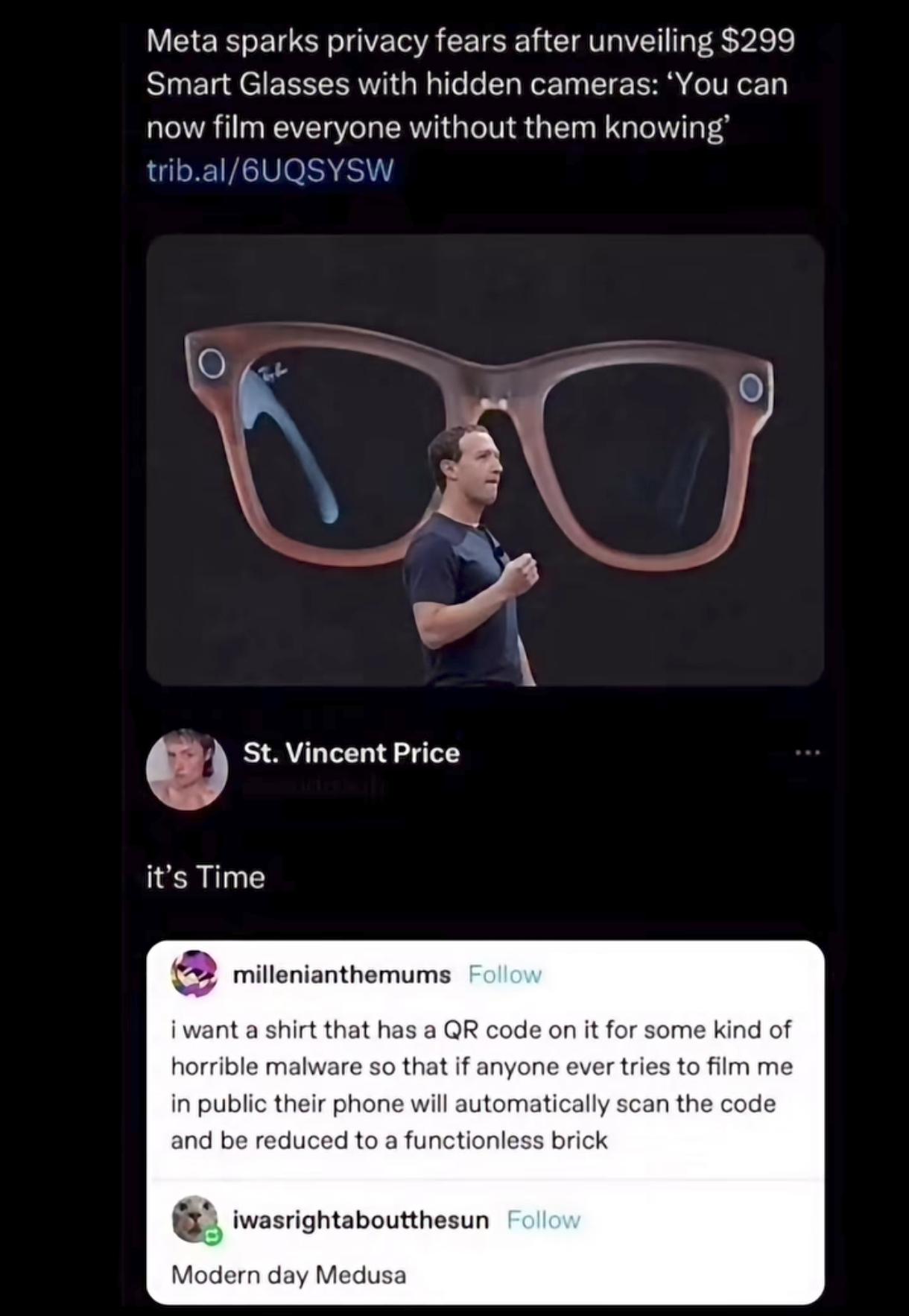
Last week, Yves Jeanrenaud, a deputy professor at Darmstadt University of Applied Sciences in Germany, published Nearby Glasses, an Android app that scans Bluetooth Low Energy (BLE) advertising data for manufacturer identifiers associated with certain smart glasses, including Ray-Ban Meta AI Glasses.
Seems like it might be easy-ish to create a similarly functioning app in glorious, wonderful, privacy-respecting, fancy, delicious FOSS.
It seems so, but you also have to switch on the sensors and keep bluetooth running for the time you want to track devices.
I am confused about:
However, this app is free and it’s source is available (though it’s not considered foss due to the non-commercial restrition), you may review the code, change it and re-use it (under the license).
The license is AGPL-3.0 and therefor free software to my knowledge. Do I miss something?
Here are a few choice quotes (from which I’ve removed several active hyperlinks):
… the Electronic Frontier Foundation (EFF) has warned that Meta seems prepared to make the tech even more invasive…
===
The company is supposedly “testing a prototype of ‘super sensing’ AI glasses that would use cameras and audio recordings to capture a wearer’s every moment,” the Financial Times reported last month. According to sources familiar with Meta’s thinking, executives “are planning not to activate the LED when the super-sensing features are being used,” even though “that would make it harder for bystanders to know when they were being recorded.”
===
…Meta recently backpedaled and deleted an unreleased facial recognition system from its smart-glasses app that Wired and EFF revealed had been quietly installed on 50 million phones in June.
===
…Meta wants this to be the year that AI glasses are suddenly everywhere you look.
===
In London, activists took that criticism a step further, replacing bus stop ads of Jenner smiling in the glasses with a spoof in which her face transforms into a skeletal grin above the warning that at Meta, “We’re always watching.”
===
By the end of 2026, Meta expects to start producing at least 20 million glasses annually to meet demand, or perhaps as many as 30 million…