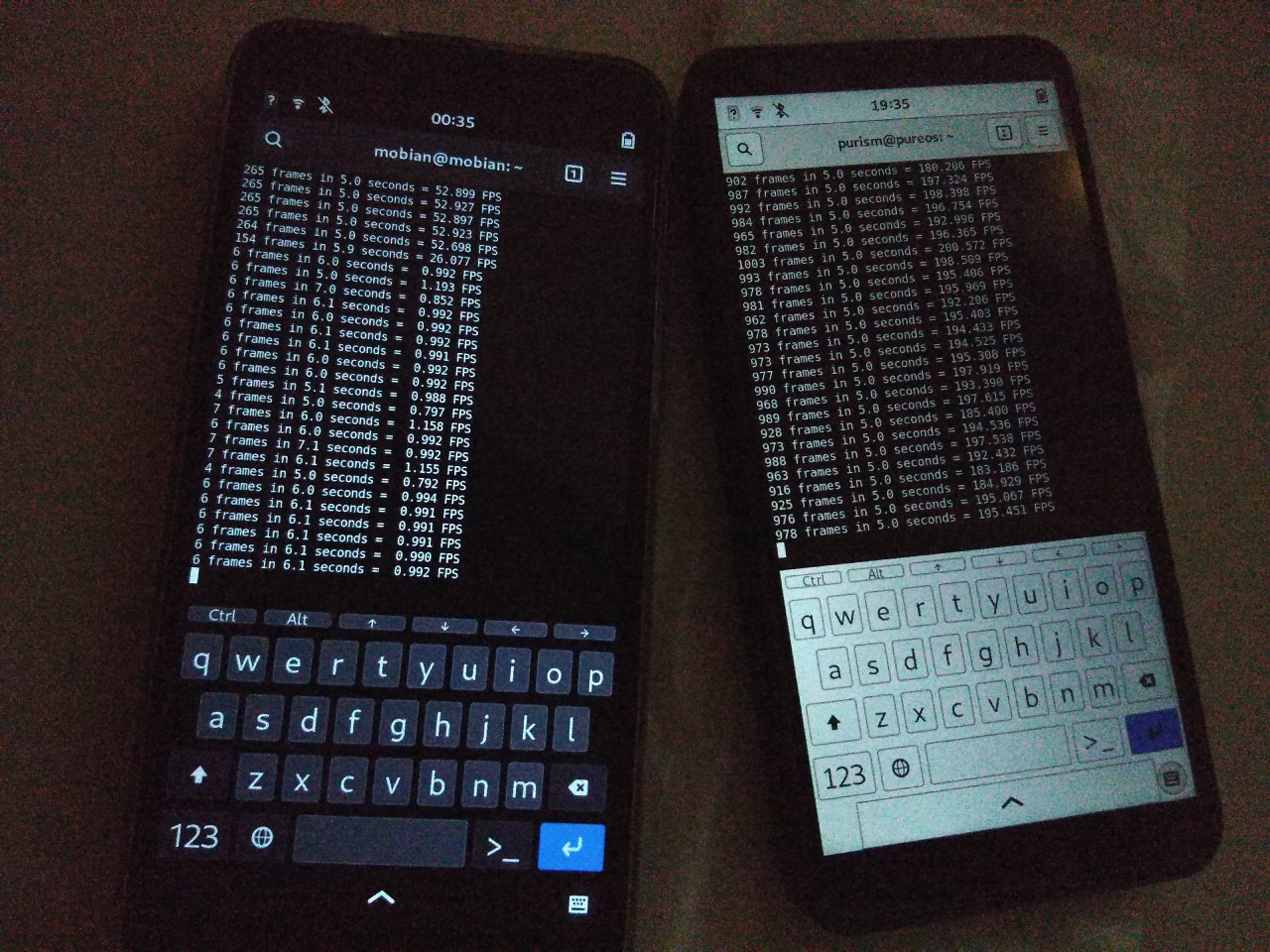
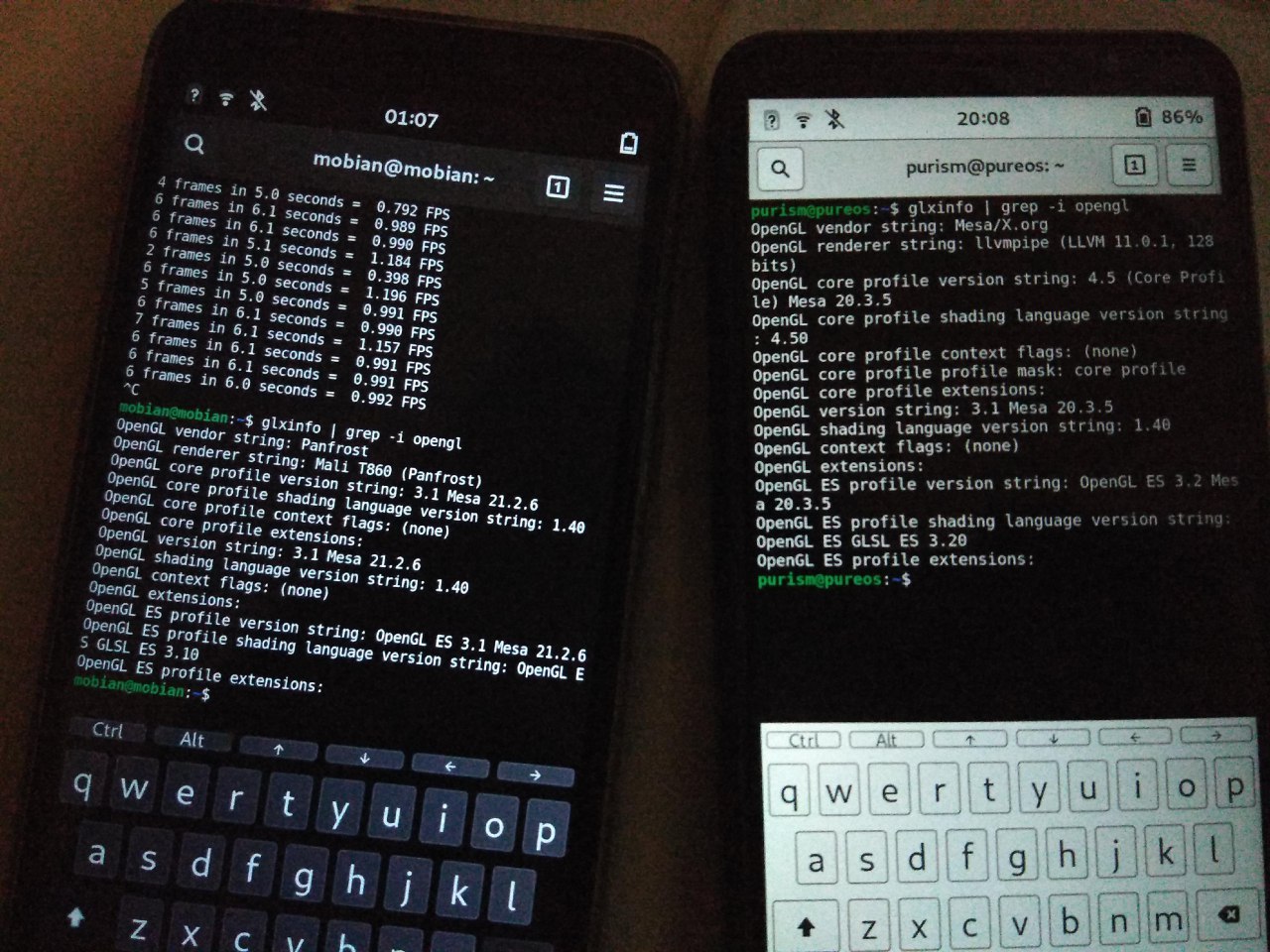
@amosbatto As a second data point, connecting a Samsung T7 portable SSD to my Librem 5 easily exceeds “150-170 MB/s”.
The marketing speed of that SSD is 1050 MB/s but you will need a USB 3.2 port and good hardware to get that.
Testing that drive on a USB 3.0 port on my desktop gives 403 MB/s. That gives us something to compare with that is not a marketing speed. (On slightly better desktop hardware, and with the earlier Samsung T5, I can sustain somewhat over 500 MB/s - in any case still limited to 5 Gbit/s USB marketing speed, both that drive and the USB port.)
Now testing that T7 drive on my Librem 5 gives 249 MB/s. That’s not setting any records but it is well above the quoted bug limit. Even a cheaper other brand SSD on the Librem 5 manages 235 MB/s.
Adding:
Using --direct when testing, as @dos did, allows me to get as high as 297 MB/s, still not setting any records but stretching the gap between the claimed bug limit and what can be achieved even further.
Its cool you got the Pinephone Pro in your hands, did you get the qwerty keyboard case add on too? I think what will continue to hold up Pinephone regardless of its improvements in hardware are that no one is really developing any of the many OS’s it can run. I mean I heard Pine64 has named Manjaro KDE Plasma mobile as its default OS, but if Pine64 is not committed themselves to get the OS working better and just relies on the community, it might never be a viable daily driver?
Yeah i bought the pinephone pro just because i heard from an unoficial webpage that pine64 is going to increase the price to 600dls in march or april, but i’m not sure if it’s true, anyway i bought this device too only because it has a libre driver right now with vulkan, but honestly i like the L5 better than PPP, and for many reasons that i won’t mention right now. Many people don’t know that Phosh will never work 100% on PP or PPP, because these devices use an incomplete soc.
Also i think it’s not right that Pine64 quickly launched PPP with a different soc, this is a bad practice that devalues/depress the user. Right now the little community power for the PP is divided for the PPP, this slowing down the stability of the first PP, but i guess that Pine64 released the ppp just for the panfrost.vk driver to work good with gtk4.
I not have the qwerty keyboard case.
The little time i using the ppp i know that is not work good at the moment, the cpu feel super slow, and poor battery life.
I luv the idea of the qwerty keyboard snap on case, especially a linux phone where one could be on the terminal a lot. I just wish Pine64 cut a deal with some organization that could work on making a more functional OS on it. UBPorts and Purism could be options, but Pine64 building hardware but not having the foresight that OS’s may struggle on it, hurts their devices. I mean if someone asked me best OS on Pinephone, my answer would be none. KDE Plasma mobile, Phosh/Postmarket OS, Ubuntu Touch, Sailfish, etc all have decent UI, but are hardly functional, especially to say the average consumer.
Pine64 builds the Pinephone Pro and still doesn’t have a real solid OS for it. They could build the Super Duper Pinephone X Pro Deluxe and still not have an OS on it that is all that functional, and they are pretty much telling their customers, you are on your own.
I wonder if they were talking about a future Retail Edition, sold from webstores in Europe and N. America with a 1 year warranty. The RK3399K is in stock, so I don’t think Rockchip is having the same kind of chip shortages as NXP with the i.MX 8M.
Can you explain this? I’m curious what the A64 and RK3399S lacks compared to the i.MX 8M Quad.
The Librem 5 SoC might not be obsessed with saving energy every milliseconds in Giant Mode because was not for it purpose but does in Dwarf Mode(not enabled yet) however the Librem 5 SoC is obsessed with durability, longevity, security, and modularity which all other phones lack. It is a key features for L5. And even more impressively, the Librem 5 is capable of things you can not even imagine! like Guardian Mode which it is a extra security layer for Lockdown Mode and lot more things…
I see a necro of this thread after so long, and I saw the title, and I wondered: is it even worth rereading the thread to catch up? Pinephone is so bad. Every time I use PinePhone something is not working.
When I use Librem 5 it’s nice and the problems are the society not allowing it to be what it wants to be, or not allowing me to use it. Most reasonable problems that can be solved are solved. Sure after two years I have a problem like Locked out of L5 randomly in a new way - #7 by Dlonk , but with a PinePhone weird freezes and crashes would happen every time I use it, almost without fail.
Was PinePhone pro actually better? Saw mention of one earlier in the thread here.
My PinePhone with 3GB RAM and Mobian/Phosh works, but it’s RAM, eMMC and GPU are so slow compared to the Librem 5 that I don’t enjoy using it and it sits on a shelf. See my benchmarks of the PinePhone is compared to the Librem 5.
The PinePhone Pro has much better performance, but lots of components don’t work due to lack of software support. See the list of what still doesn’t work:
I have a Pinephone – modem died, can’t replace it, so now I have a tiny Linux tablet. Not terribly useful.
PPPro was not better. It was more performant, but the software development lagged compared to the Plain Old PP. That’s almost certainly why they no longer make the PPPro, but still make the POPP.
My L5 is way better than both PP models. My only wish is that it had 8GB RAM and 512MB eMMC.
Edit: Ugh! That should have been 512GB eMMC. (Thanks @irvinewade !)
 but you will need a USB 3.2 port and good hardware to get that.