The PinePhone and PinePhone Pro are the only other truly Linux phones that you can buy with Linux preinstalled, since the rest use Android kernels and then run the rest of the Linux stack on top of libhybris. If you buy a “Linux” phone from Volla Phone, F(x)tec, jolla-devices.com or Planet Computers, you are getting an Android kernel that will probably never be upgraded, and it won’t get security updates after a couple years when Qualcomm, Mediatek or Google decide to stop providing security updates for it. In addition, you will get a bunch of proprietary blobs that you can’t audit or upgrade, because the manufacturer only supports them for a couple years. In other words, you will probably junk the phone in a couple years, because it can’t be upgraded and will likely become a security risk.
Yes, you can install PostmarketOS with a Linux kernel on some Android phones, but even if you have a phone with a Snapdragon 845, which has the best mainline Linux support of any of the mobile SoC’s, you will only get a half functional phone with major components on the phone not working.
If you buy the F(x)tec Pro1 X, you may never get your phone. If you buy the Volla Phone, Volla Phone X or F(x)tec Pro1 X with Ubuntu Touch, you are getting an operating system which doesn’t have enough volunteers to properly maintain the code. Over the last year, I can only find 25 commits to the core software (24 commits for Lomiri and 1 commit for Ubuntu Touch), whereas all the rest of the dev work is for installing Ubuntu Touch on different devices and configuration (153 commits for ubports-installer and 116 commits for ubports-configs). Yes, the Volla Phone did get the OTA-15 through OTA-23 updates, but as far as I can tell, there is almost no work being done on Ubuntu Touch itself, so you are relying on unmaintained code.
If you buy the Planet Computers Gemini and install Debian on your own, you will be stuck with Debian 9 stretch with no possibility to upgrade to a later version of Debian. If you bought the Planet Computers Cosmo and installed Debian on your own, then your last update was 17 months ago with this lovely note:
28/04/2021 - The latest Linux Debian firmware v4 is now available!
Please note we are investigating an issue related to not receiving incoming calls with this version of Linux.
As far as I can tell, Planet Computers has now given up on Linux, since there is no Debian port for the new Astro.
If you buy a Sony Xperia with a postmarket install of Sailfish OS by jolla-devices.com (which isn’t the same company as Jolla), then you are getting no tech support for the software except for what you can find on the Sailfish OS community forums (although jolla-devices.com does claim to supply a 1 year hardware warranty for the device) and it only offers devices for the European market. Unlike Ubuntu Touch, Sailfish OS is well maintained, but it relies on some code such as oFono and ConnMan which aren’t nearly as well maintained as ModemManager and NetworkManager used by PureOS and most standard Linux distros. Jolla actually does a decent job of providing updates for Xperias, but as far as I can tell, you will get no kernel upgrades.
If you want a real Linux kernel that you can upgrade and will have long-term support, your only option besides the Librem 5 are the PinePhone and PinePhone Pro. The PinePhone Pro has “critical bugs” in U-boot and its SPI memory code is “unfinished” according the PINE64 wiki, so you are going to have problems booting it. With the PinePhone and PinePhone Pro you get a 30 day hardware warranty and basically no support for the software other than what you can find on the forums.
The PinePhone is fun to tinker with in my experience, but it is slow and laggy compared to the Librem 5 due to poor RAM, eMMC and graphics performance. (See my benchmarks). There is no place to file bug reports with PINE64 about its hardware, and I was unable to get PINE64 to fix the errors that I found in the PinePhone schematics. Despite having shipped over 60k PinePhones, PINE64 has never fixed their hardware design to address the screen backlight flicker due to communication on an I2C bus and slow eMMC speed.
The major problem, however, is that Purism is the ONLY company selling a Linux phone which is doing any software development, which is critical for making mobile Linux good enough to become a usable system. According to PINE64’s poll of PinePhone users, the most popular interface is Phosh, which was developed by Purism, so many of the PinePhone sales depend on dev work being done by Purism.
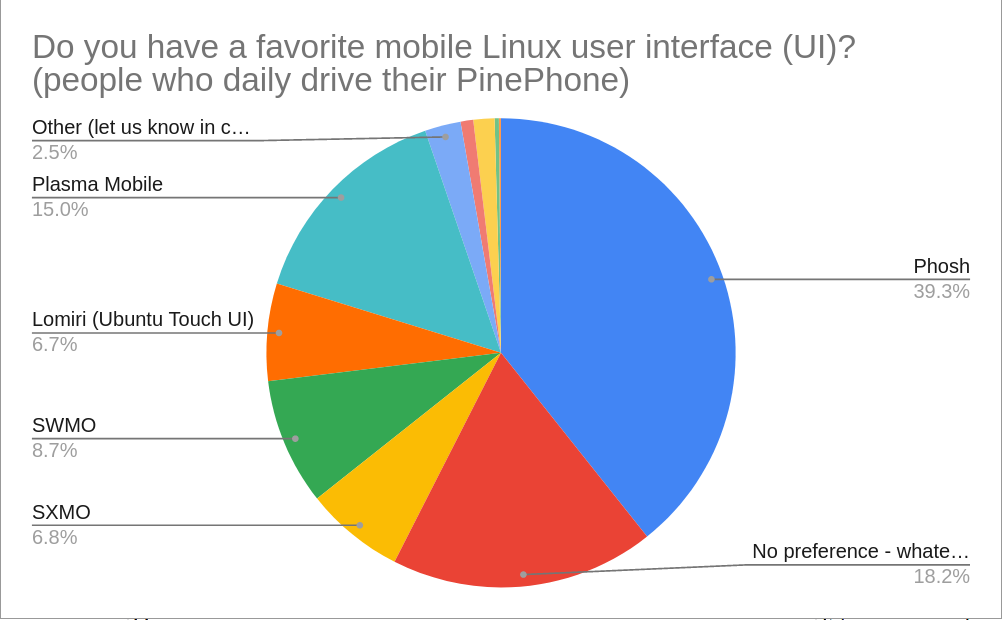
If Purism ceases to exist, then the only companies paying for development are Jolla (which develops Sailfish OS, but has no licensed hardware sellers) and Blue Systems (which pays a few developers to work part time on Plasma Mobile). In other words, buying a Linux phone from another company does nothing to actually develop mobile Linux, so we have to rely on 100% volunteer labor, which means slow and spotty dev work. A good example of what happens with volunteer labor is that critical kernel code for the PinePhone has never been submitted to mainline Linux, so the phones will have to keep using custom kernels.
The critical thing is that no company is going to arise to take Purism’s place if the company fails, because many tech companies before Purism tried to pay the high costs of developing mobile Linux and they lost millions of dollars and gave up in failure. Jolla has managed to get out of bankruptcy and limp along for many years, but Sailfish OS will never be adopted by the community due to its proprietary Silica interface. Samsung has given up on Tizen as a mobile OS now that its watches are switching to Android. LG stopped working on WebOS as a mobile OS years ago, since it is only focused on using it in TVs and refrigerators. I doubt that Nemo Mobile will ever become a usable interface, and Ubuntu Touch’s Lomiri simply doesn’t have the volunteers to maintain its code.
Our only real choices are Plasma Mobile, Sxmo and Phosh, because those are the only FOSS mobile Linux interfaces getting real dev work. Sxmo will only ever appeal to a small crowd of geeks, so I don’t see it as a viable option for most people. Plasma Mobile has been in development since July 2015, but it is considered by most people to be less usable than Phosh, which started its development in January 2018, which indicates the speed that mobile Linux will develop with 100% volunteer dev work. If the goal is to create a viable alternative to the Android/iOS duopoly, we need paid development of software that works with one of the two existing ecosystems (GNOME or KDE) so it doesn’t become siloed and eventually abandoned.
As I see it, supporting Purism is the best path available to actually getting functional mobile Linux. I don’t care for some of Purism’s marketing and I especially disagree with how Purism retroactively changed its refund policy, but I have decided to support the company because of its open development and willingness to work collaboratively with the larger GTK/GNOME community. I have dealt with a number of tech companies over the years, and I have never seen a company where it is so easy to interact directly with developers and they will go out of their way to answer my questions.
If Purism disappears, it is extremely unlikely that another company will arise to take its place, because it is not rational to invest in mobile Linux development after witnessing the business failures of mobile Linux at Sharp, Motorola, Nokia, Intel, FIC/OpenMoko, Wind River, MonteVista, Azingo, Samsung, Palm->HP, Mozilla, Arcadine, Canonical and arguably Jolla. Our realistic choices are either supporting Purism or accepting volunteer development of mobile Linux, which means that mobile Linux will be largely unusable by ordinary people for a long time. It is simply not realistic to dream that another company with better financing will magically arise and dump millions into mobile Linux development, like Purism has done.