Given that 5G won’t function outside most cities due to the high cost of implementing it, I think that we can count on 4G LTE being used for the next two decades. A number of companies are currently investing in advanced forms of LTE, that frankly makes a lot more sense than 5G in my opinion.
Considering that 2G GSM is just now being retired and it was first introduced in 1991 in Finland, I don’t think that we have anything to worry about.
About 80% of the total greenhouse gas emissions for a phone lie in its initial fabrication and shipping to point of sale. If the Librem 5 lasts 5+ years, it can be a more environmental phone than the typical Android phone that only lasts 2-3 years, if you keep using it or resell it when you no longer want it. Given the Librem 5’s unique features and its rarity, I expect that it will have a better resale value than even iPhones and Galaxy S’s and the market for used smartphones is rapidly expanding, so a long lifespan is likely.
However, the Librem 5 probably won’t be a very environmental phone, because it will take more energy and resources to create it than a normal phone. It will have separate chips for its cellular baseband, GNSS, Wi-Fi/Bluetooth, conversion to HDMI/DisplayPort Alt Mode (maybe?), digital signal processing for the camera (maybe?), and fast charging, which a normal phone has in a single SoC whose die size measures about 70 mm2 in a mid-range phone and 90mm2 in a flagship. In contrast, the Librem 5 will probably need 250-300 mm2 of silicon to implement the same functionality in different chips, plus it needs a big heat spreader in the cellular modem, an M.2 slot and a smartcard reader. All of these factors will increase the environmental costs of producing the Librem 5. On the other hand, the smaller amount of DRAM and Flash in the Librem 5 will decrease that cost to some degree, but not that much.
In addition, the Librem 5 will require more frequent charging because its SoC isn’t that energy efficient and having lots of separate chips consumes more energy. However, the operational energy usually isn’t that big of a factor.
On the other hand, the Librem 5 won’t be constantly connecting to Google servers like the typical Android phone (and even the typical iPhone) and consuming as much energy in the network. The energy to operate an Android phone is about 1/5th of the energy to operate the network and servers that feed a phone its data, so not constantly sending information to Google and other online servers is very important environmentally.
The question is how to weigh all these factors. I sat down and tried to guesstimate them:
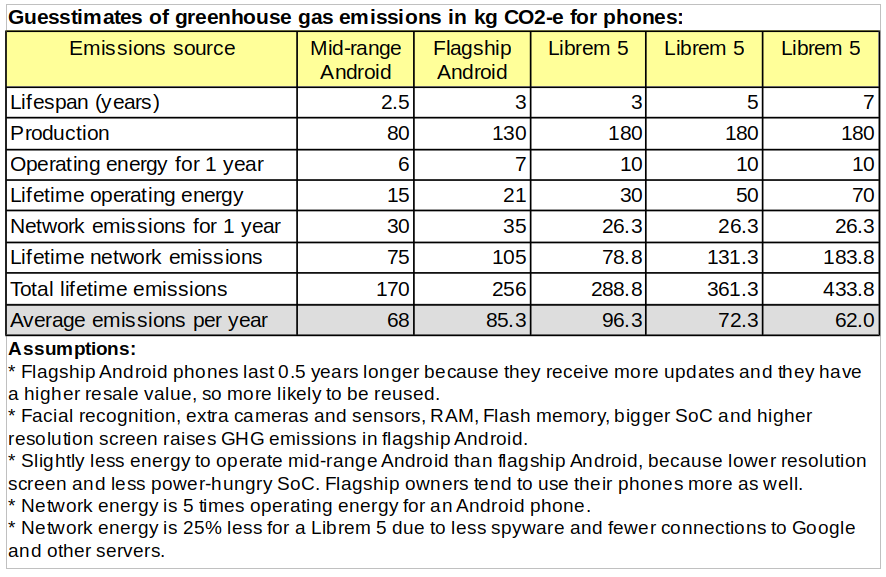
If my assumptions are correct, then the Librem 5 has a higher carbon footprint than other types of phones if it only lasts 3 years. If it lasts 5 years then its footprint is between a mid-range and a flagship Android phone. If it lasts 7 years, then it is the most environmental phone.