I really would like the opinion of @amosbatto about Librem v2 Hardware.
Tracking page: Purism – Librem 5 v2 – A phone that frees us all - Just the phone 1599$
Technical Specifications
Librem 5 v2
- CPU: Eight-core RISC-V SpacemiT K1 CPU
- Screen: 5.7″ (720 x 1440)
- Memory: 8 GB
- Storage: 128 GB
- Hardware Kill Switches: Cellular, Wi-Fi/BT, Microphone/Cameras
- Cameras: Front: 8MP; Rear: 13MP
- SIM: Dual SIM
- SD: 80 MB/s (SDR104)
- Headphone Jack: 3.5mm
- Charging: Type-C
- Second Screen: Type-C
- Battery: Removable 4500mAh
- Smart card slot: Yes, with free firmware
Librem 5 v2 DevKit A deconstructed Librem 5 v2 in its earliest stage
- Mainboard, RISC-V
- Type-C board
- Screen / Chassis
- Modules: Cameras, Wi-Fi/BT, Cellular, Toggles
- Cables
- Battery
Librem 5 to Librem 5 v2 upgrades
Benefits
Cooler: The Librem 5 v2 will operate at a cooler running temperature.
Faster: The Librem 5 v2 will operate at faster speeds.
Efficient: The Librem 5 v2 will have a longer battery life.
Features
CPU: The Librem 5 v2 runs an eight-core RISC-V SpacemiT K1 CPU, (The Librem 5 runs a quad-core ARM64 NXP CPU).
Memory: The Librem 5 v2 is 8GB, (The Librem 5 is 3GB).
Camera:The Librem 5 v2 takes 13 MP photos and HD video, processed on the faster CPU and with hardware encoding, (The Librem 5 takes HD photos and SD video with low fps, processed on the CPU).
SD Card:The Librem 5 v2 SD card supports 80 MB/s, (The Librem 5 SD card supports 10-14 MB/s).
SIM:The Librem 5 v2 is dual SIM, (The Librem 5 is single SIM).
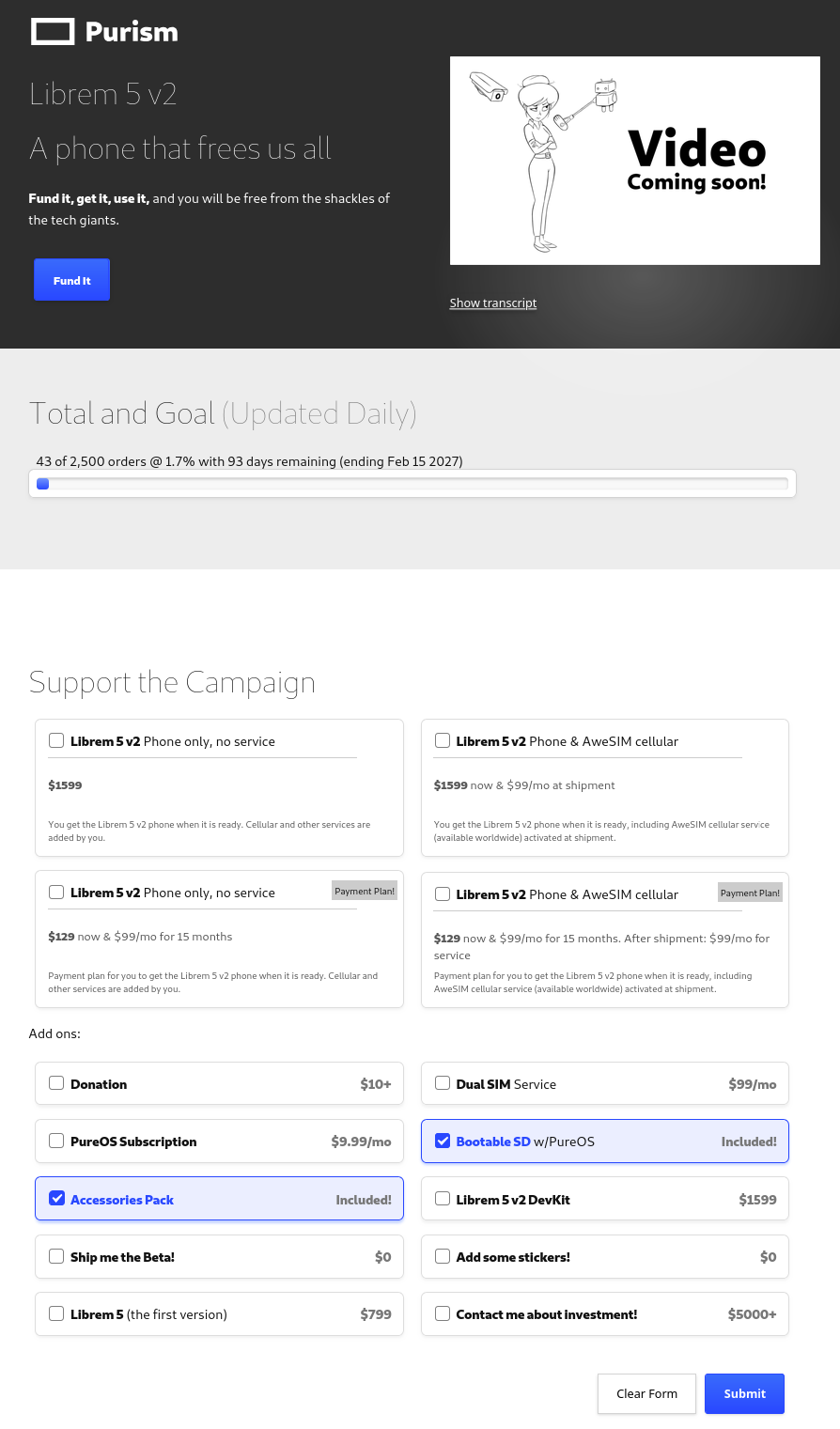
I take note that modems are not mentioned, what card is supposed to come with it (huge impact on usability). Also, cameras are a bit “meh”. But more importantly, “ARM64 compatibility: We must be able to execute ARM64 code efficiently to support Flathub and Android apps. ARM64 emulation for RISC-V exists, but needs optimization.”, which may be a much bigger issue. Oh, and I’m sure a few eyebrows will raise, when they see “Rapid delivery 15 months after campaign close” from Purism. Although the step-by-step plans are better than with v1 campaign, the troubles they had with that delivery have not been addressed, which may become a weight around the projects neck (btw. FAQ includes " Can I get a refund? No. There are no refunds.").
At the time I joined the crowdfunding campaign of the Librem 5; and it was a huge disappointment. I still have the phone but it is essentially unusable in everyday life with several problems that keep appearing and some that have never been solved, including GPS location, power consumption and the space problem in the boot that has recently recurred with all the complications of the case to fix it..
In any case the fundamental problem is the consumption / poor battery life.
A generic statement about the lower consumption of the new version is provided but no numerical data is provided on this matter.
One, two, or three more hours of use wouldn’t change the situation much, given that with the current one, it’s difficult to get to the end of the day even with the data connection turned off.
How many hours of use can you get with the new version and what guarantees from the manufacturer regarding this?
Some data from the processor: https://cdn-resource.spacemit.com/file/chip/K1/K1_brief_en.pdf
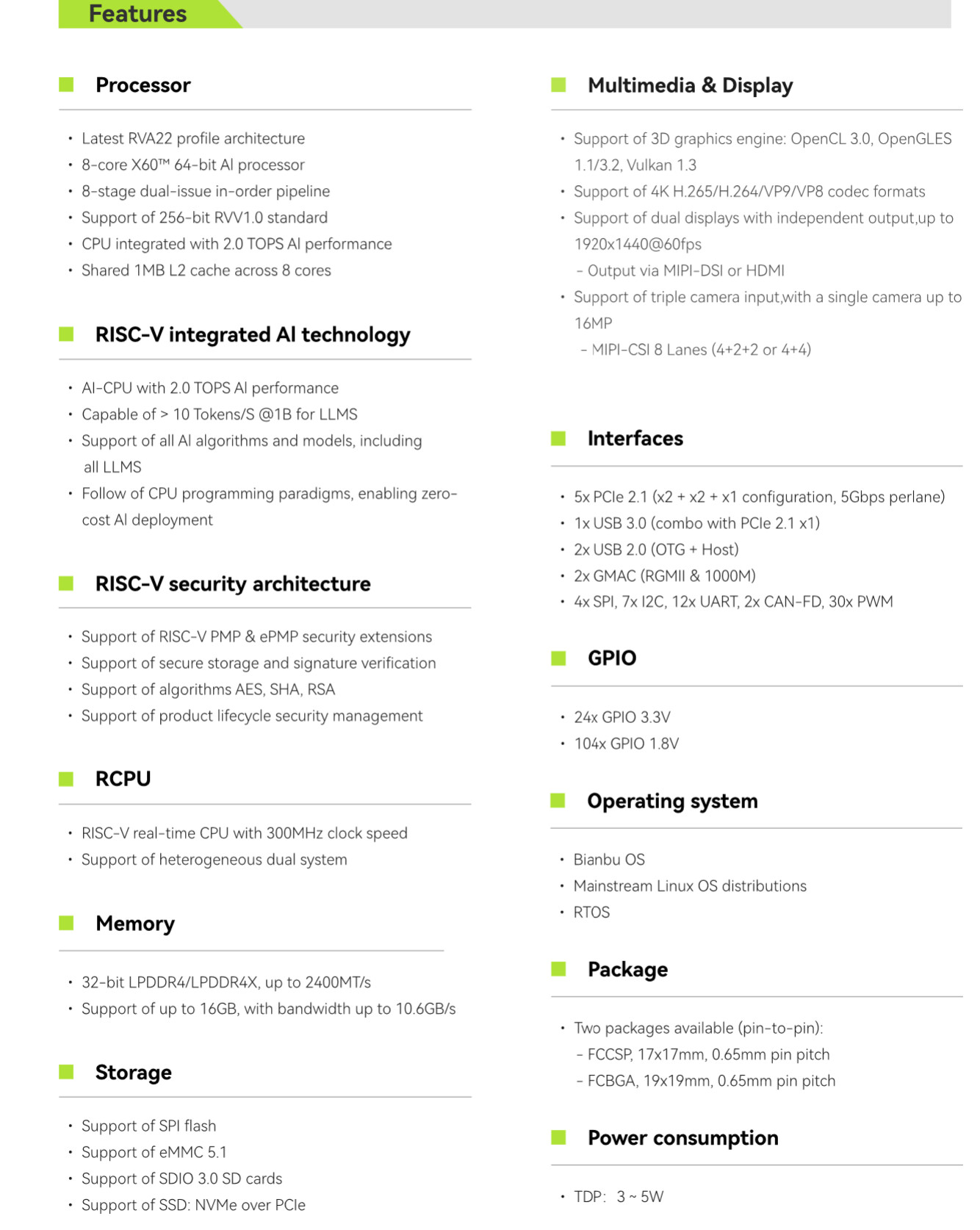
No deep analysis but first notes:
- Max camera Mpix is 16 (so cameras could have been slightly improved, but not much)
- A lot of emphasis on AI computing (2TOPS, which isn’t that much but a lot more than nothing)
- I wonder if its USB is going to limit all transfer speeds to current levels
- It’s nice that standard encryption algorithms are supported but these days, if PQC algorithms aren’t included, it’s not very future proof (may not be a huge issue)
With these specs, memory upgrade etc., this seems more like a “fix” of v1 than a totally new model (the from and size are the same, after all). That’s not bad. Might even be good. I wonder though is it going to be too late with these specs and timeline.
I wonder, will there ever be a replacement motherboard for v1 owners..? FAQ says on Can I upgrade my Librem 5 v2 with the new electronics? “The Librem 5 v2 is designed with the same chassis as the Librem 5 v1 combined with new electronics. We expect to make electronic components available as supplies permit following production. Separate components are not available during the campaign period in order to meet production volumes for all components.”, which is not very promising - if they are that far a way, makes them irrelevant for current needs (does not serve previous customers and the community).
The Librem 5 remains Purism main accomplishment. With the ability for agents to run local on the phone I have fixed almost all of the issues I had with my L5.
For me an updated L5 needs more RAM and more performance. Doing that on hardware that is not as supported and doesn’t have as much driver support is a cause for concern to me.
FOSS hardware is great in theory, but still requires too much compromise. I guess it still remains to be seen how much of a hit this focus on open hardware really has here.
I think most hardware changes are not necessarily the huge deal to me. But the fact they are already going RISC-V as architecture. Current support of RISC-V by major Linux distributions is rather slim. Flathub doesn’t even provide packages for it and I would assume that most application maintainers don’t even have a proper build path ready.
So that will require a lot of effort to build an open ecosystem around it. Just as example think about the struggle to get Signal running on the current Librem 5 with arm64 chip. On RISC-V there’s very little chance at the moment to get that working, I’d say.
…and sure, the official post says that Android apps could be run via Waydroid. But does Waydroid actually work on RISC-V yet? I certainly haven’t tried yet. Last time I checked web browsers like Firefox were still struggling. So even web apps could be a demanding task to get them working.
That’s why I think at the time, it’s not as important to see major hardware improvements. It’s mostly important to get free drivers and firmware going. Then applications need to build and function properly.
I think Linux devices (eg: Librem5 pocketpc with phone function) have to be necessarily used for limited private/secret life but working alongside Apple/Android because most of us can’t avoid last one! Banking apps, socials, IoT (eg: my vacuum robot cleaner,..) make it impossible! It’s like to live as hermit on the top of a mountain! Few can, most of us can’t (although they would)…
Moreover Linux will always have delays and limits compared to competitors due to business so the best approach, in my opinion, is to have it, to use it but still having in mind to low/reduce expectations! Never compare Librem5 with Apple and Android!
Lastly, regarding battery duration, I bought 2 batteries..  (and, in case, I’ll buy a third one)
I think the best representation is Dr. Jeckyl and Mr. Hyde 
I haven’t seen much discussion about the Linux kernel and driver support for the SpacemiT K1 . As far as I can tell, the SpacemiT K1 currently requires vendor kernels for VPU. The FOSS GPU drivers (powervr) are immature/experimental and at this point is vulkan only (OpenGL still requires proprietary blobs). And, while this is becoming more common, I think that for the GPU to function at all there is a required proprietary firmware (rgx.fw.*).
I will say that the “NPU structure” is more open and is an open extension of the RISC-V instruction set (the Integrated Matrix Extension) whose support is already in the mainline RISC-V kernels (if I understand things correctly). So that’s nice. But I’m not really sure how excited Purism customers are for AI applications. Personally I think power efficient voice-to-text, text-to-voice, and OCR would be very useful.
Honestly, I would be careful of Purism’s advertising … especially given the advertising relative to the first delivered Librem 5s.
When reviewing, please consider the following.
There is ore-edk-boot-opi, which boots OrangePi R2S and OrangePi RV2, including RAM initialization, without proprietary blobs. Those boards have SpacemiT K1 (sold as Ky X1) too. I have not reviewed the project, but, assuming that it is legit, it is likely that Purism will be able to make Librem 5 v2 boot without any proprietary firmware in the boot chain, unlike the current Librem 5. That allows to get rid of the secondary processor for RAM training, which is implemented in the current Librem 5. It also makes it more likely that the free software community and FSDG-compliant distributions may get interested in the device.
Mesa explicitly lists BXE-2-32, a PowerVR GPU by Imagination Technologies, as “unsupported and not under active development”. Purism is likely to join the ongoing community effort to reverse-engineer the driver from the published drivers for newer models. There is a large community of users owning different devices with that GPU who would like it to be free software. It also worth noting that, long ago, reverse-engineering some other older PowerVR drivers, which were used in the phones, used to be on the FSF’s high priority projects list. But, even if the efforts for the driver succeed, there are no efforts for the firmware blob for the GPU. Because of that, the free software community is likely to ignore the GPU and focus on software rendering instead. The presence of a version of RISC-V vector extensions support in that CPU makes it interesting. See also ORCJIT backend.
But Purism will likely use firmware jail again, so the situation with the RYF certification is back to the question of whether the firmware jail is an acceptable workaround.
Finally an updated Librem 5! I was an early backer of the original Librem 5. After a long but exciting wait I was using the Librem 5 as my main internet on the go device for about three years. Unfortunately it was not reliable enough for my telephone needs, so I purchased and carried around an additional simple phone. Now I’ve been using a Shiftphone 8 with google-free Android on it for two years - but somehow I do miss the sturdy L5, and the feeling of real Linux in my pocket!
So I’ll sure follow this crowdfunding campaign closely, and maybe join before it ends. Right now my financial situation is not up to it, though, I’m afraid. The price seems high to me, seeing that a K1 laptop (detailed review, promising!) costs less than $600, and a Raspberry like K1 board even less than $100… but I understand this money is used to developing something new, and unique.
The change from ARM to RISC-V seems like quite a challenge, to me. This will certainly make it harder to support Android apps. I´m lucky I barely need any, though. My most important communication partners use XMPP (for the contact with me). I do need Signal for some others, though, and would like to see a solution for that. I certainly want better battery life/ less heat. For convergence more performance will also be welcome. On the go, the camera is now really important to me - I hope that will also see some improvement (even if it will certainly not match “golden cage” devices for more than $1000).
Risc-V would be my fourth architecture to run Linux on, after x86 (several), PPC (3 Apple G4 computers in the early 2000s), and ARM (Librem5, Pinebook, NanoPI, and 3 RaspberryPi), so thatˋs exciting too. Open source becomes more important on exotic architectures, and Java also turned out to be pretty useful…
I don’t think that’s completely true. My understanding is that Android apps are actually Java Virtual Machine (JVM) bytecode. So the app operates regardless of the underlying Instruction Set Architecture (ISA). Of course the JVM itself and some of the runtime does need to be ported to RISC-V. (My understanding is that the JVM has already been ported to RISC-V. So it’s really just work on the runtime, which is of course quite large.)
But, like you, my “need” for apps is low. So support for Android apps is not a priority for me personally, and there is plenty of work even to get a working RISC-V native phone, never mind about Android apps. Android apps may well be key to wider adoption though because other people do love their apps.
The video is now also available on the campaign page:
It sounds like Librem 5 v2 still has a removable battery, which should mean that the user can take batteries in and out while the device is on throughout the day, which should hopefully mean that the device can stay on without charging for multiple days by occasionally touching a wall charger into the USB port, popping out the battery while it’s still on, and putting in a new fully charged battery.
If this existing Librem 5 solution continues to work on the v2, then its battery life for me is arguably superior to the Androids and iPhones and arguably superior to what they will ever be, because it has literal instantaneous fast charging (via putting in a new battery that is full) that the other devices completely lack.
–
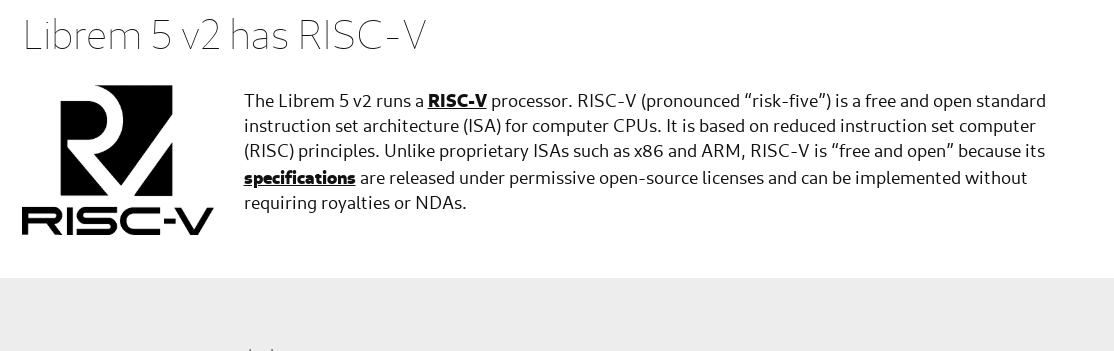
That aside, my knowledge of RISC-V is very limited but the website URL on the Librem 5 v2 page links to a site that is entirely in Chinese (or some similar language I don’t know).
I had a moment one time where I was in a church and an older man was talking about his iPhone and how he wanted to like it, but he knew it was made by humans in buildings with suicide nets that were in deep mortal suffering. I happened to have the Librem 5 Liberty Phone (made in USA) in my pocket as my phone at the time, so I popped it out and told him that I solved that and used a phone made by nerds in California who were not in mortal suffering and didn’t have suicide nets, even though mine cost 3 times more. And I was happy about it, I felt like I was in a place of people who came together to aspire toward good things (i.e. whatever place of worship – I’m not a big believer in their exact stuff but they’re open to people talking about that and they’re friendly) and amongst these discussions of hoping towards good things I felt that having a phone that cost 3x more but wasn’t made with suicide nets felt like a genuinely good thing.
In truth, I bought the Librem 5 Liberty device because I wanted the extra RAM and storage, because I wanted the device to be maximally as powerfull as I could manage. But after I had already eaten the cost, I liked to think it did some good being made in USA.
If it is only the Chinese people who know how to make RISC-V, this might be a step backwards in that department. Hopefully it is at least getting made by rich Chinese people who don’t have suicide nets, but such people probably would sneak tiny spy devices onboard the chip when selling it to us, because they can and the people who bother to use a Librem 5 are going to be the ones worth targeting anyway.
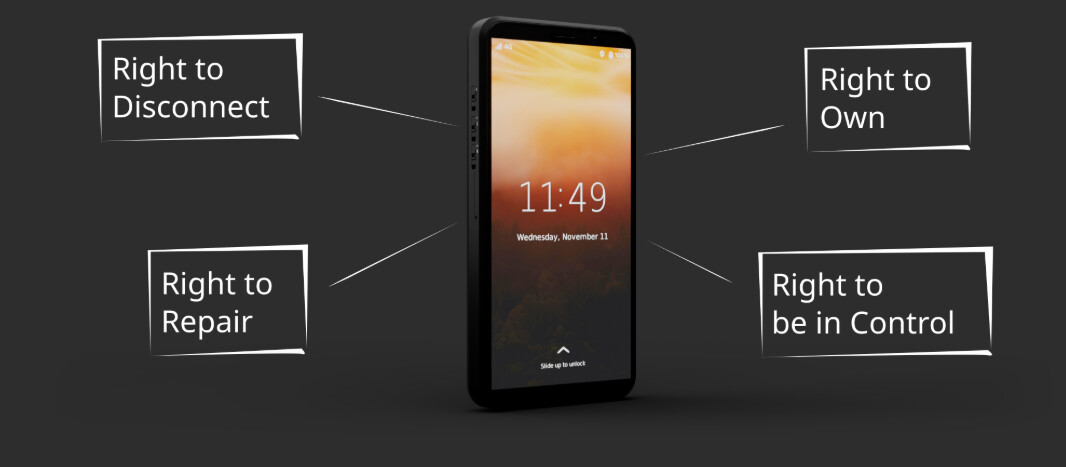
Anyone know how to pull the wallpaper on L5-v2-header image above?
Not all image can be used in Locker-Screen but this one look good, still missing some contrast on top-bar-right but is OK.