I’m running the Pure Maps and OSM Scout Server flatpaks on my Librem5 in PureOS 10. I used it successfully for offline navigation as recently as September 14th, 2025. However, when I next tried to use it the following week on September 21st, the Pure Maps GUI was extremely slow. Zooming in and out was almost completely unresponsive. My GPS location did update, but any interaction had a lag of 5 to 10 seconds. A test of routing for a short trip a few miles long took over 5 minutes.
Has anyone else noticed a change in Pure Maps recently?
Could it be caused by a flatpak update? I forgot if I ran a flatpak update between the 14th and the 21st. If someone can advise me how to check my flatpak history, I would appreciate it.
Also, when I run flatpak update, I get the following message:
$ flatpak update
Looking for updates…
Info: org.kde.Platform//5.15-23.08 is end-of-life, with reason:
We strongly recommend moving to the latest stable version of the Platform and SDK
Applications using this runtime:
io.github.rinigus.OSMScoutServer
I’m not sure if this is relevant to the problem I’m having.
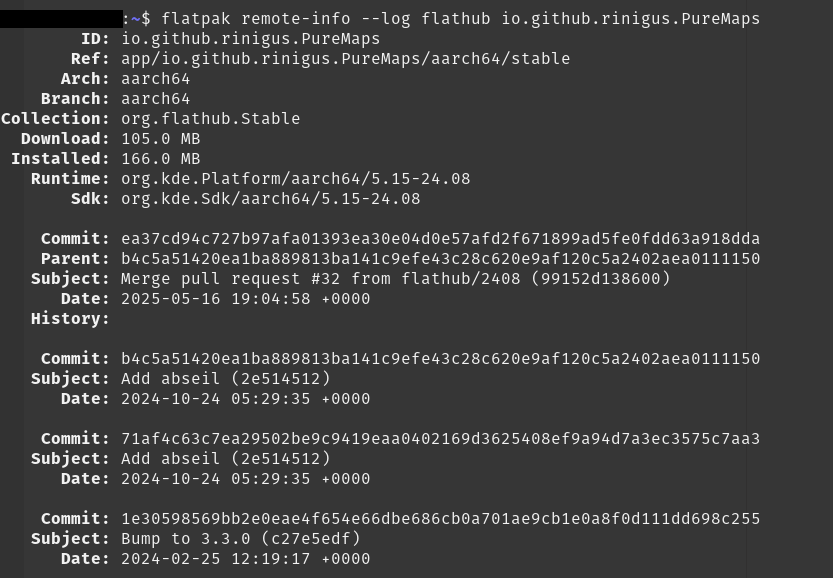
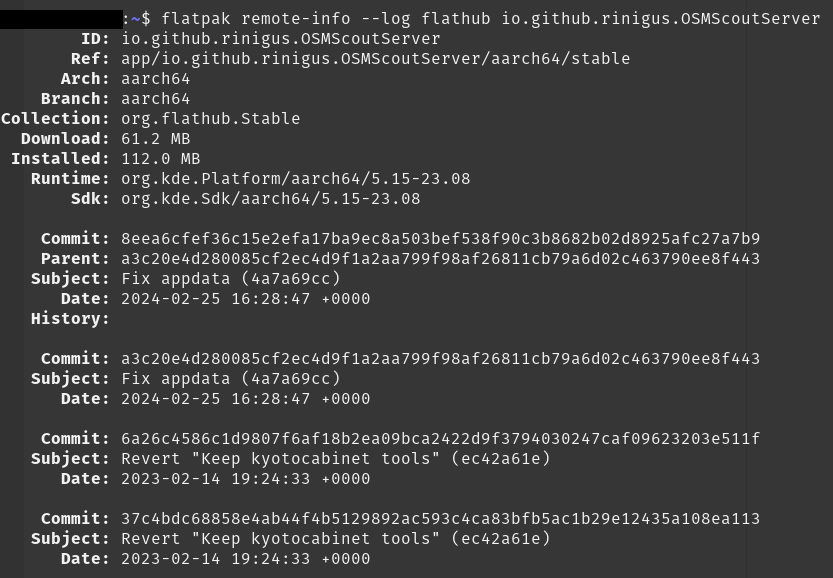
I was just looking up how to downgrade flatpaks to see if that resolves the Pure Maps issue. I was checking the previous versions of PureMaps, and I got this output:
As a workaround for now, I’d like to set the QT_QPA_PLATFORM environment variable in the io.github.rinigus.PureMaps.desktop file. I’ve tried some methods for setting environment variables in the Exec line, but they don’t seem to work.
Do you know (or does anyone else reading know) the proper way to set an environment variable for a flatpak executable in the .desktop file?
Instead of fiddling with desktop files, it’d probably be best to set up an override with flatpak override --env=QT_QPA_PLATFORM=xcb io.github.rinigus.PureMaps instead.
However, it seems I can’t run two X11 applications simultaneously, as they appear to conflict. Signal Desktop now seems to be running via X11 since the last update, and the touch commands in Signal (like scrolling) go instead to PureMaps when both are open at the same time.
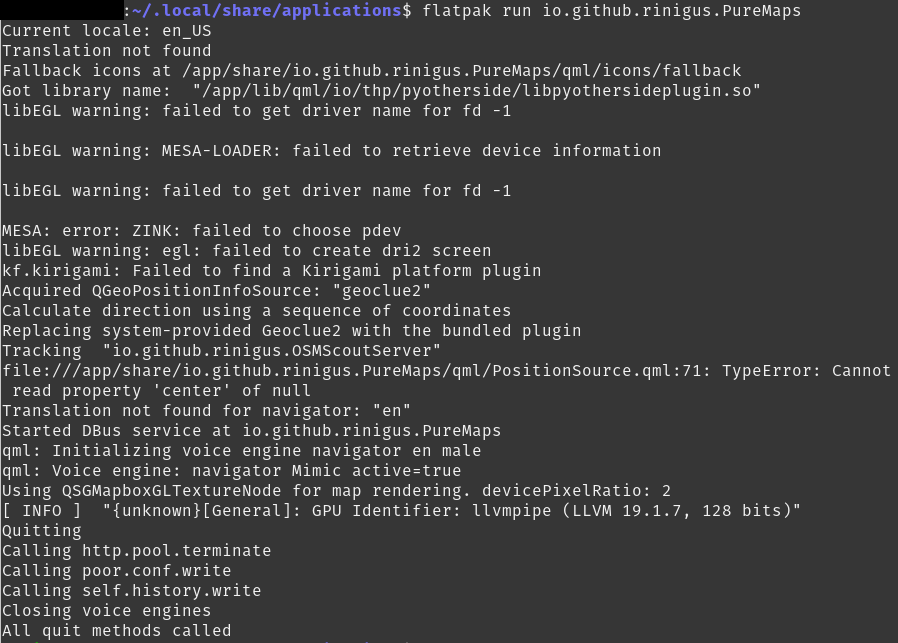
The workaround is usable for now, but is there any way to determine why GPU acceleration is now broken for Pure Maps when using wayland? I’d like to get Pure Maps working with wayland again, as the limitation that I can’t use two X11 applications at the same time could cause problems in the future.
This used to give me a fast (though slightly blurry) PureMaps via Xwayland.
After updating to the latest PureMaps Flatpak (3.4.2), this workaround no longer works on my Librem 5 - I either get a very slow, software-rendered Wayland session, or PureMaps fails to start when forcing QT_QPA_PLATFORM=xcb.
I have reported this to the developer with logs and environment details here:
If anyone else on Librem 5 can reproduce the same behavior with the current Flatpak version, it may be helpful to add your observations to that GitHub issue.
Latest versions of both Pure Maps and Organic Maps are terribly slow. Glad to know some dependency update screwed them up. Reverting to older versions of the apps does not work at any rate.
That means that we should be able to fix this by downgrading the runtime, no? I’ve tried using previous versions of org.kde.Platform and org.freedesktop.Platform.GL.default, but to no avail.
I only started noticing recently, though, when Organic Maps became unusably slow and CPU usage rose to 100% when running it. But how is it possible that this has been going on for months without anybody noticing? I assume then that it is a Librem-5-only problem?
Recent GTK isn’t accelerated at all on GLES2 platforms, and some other devices such as PinePhone have GLES2-only hardware, so it could be plausible that nobody handled that yet. But we’ll only know for sure once it’s debugged, it could be L5 specific as well, or perhaps specific to devices with split render/display nodes.
(also, it only affects Wayland clients inside Flatpak - X11 clients work fine)
I switched to Crimson (on 2025-10-28), I noticed on Crimson that Pure Maps (from flatpak) is very slow, I assumed it was a Crimson regression. I did not take the time to compare it with Pure Maps on my Librem 5 with Byzantium.
It got very slow for me on my L5 Byzantium, which is why I upgraded to Crimson
Luckily, I noticed GNOME Maps on Crimson (version 43) is much more usable now for my use case (hiking, not turn-by-turn navigation), so I switched for the time being (it’s a native package, not Flatpak so that’s a huge win).